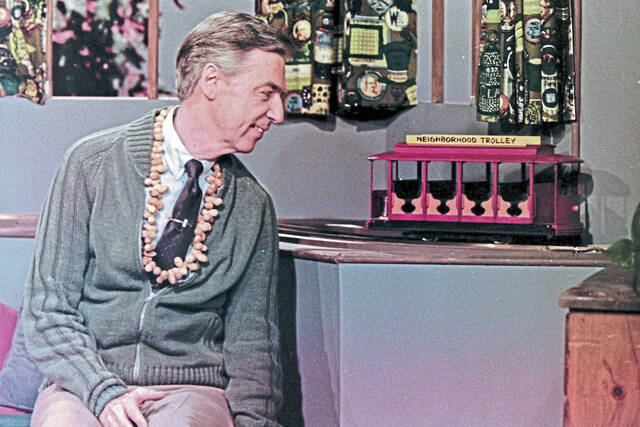
Imagine Pittsburgh without Mister Rogers.
Without public television, “Mister Rogers’ Neighborhood” would not exist.
There would be no Mister Rogers exhibit at the Heinz History Center or annual sweater drive at the Children’s Museum of Pittsburgh. No statue overlooking the city on the banks of the Allegheny. No trolley ride at Idlewild. No Fred Rogers Institute at Saint Vincent College. No Fred Rogers Productions on the South Side. No 143 Day.
No “Daniel Tiger’s Neighborhood” either.
I know. I was the director of children’s programming at PBS KIDS when Fred Rogers Productions (FRP) introduced the show idea. The first episode, they said, would be about disappointment. Daniel’s birthday cake gets smushed, you see, and he learns: “When something seems bad, turn it around and find something good.”
I so appreciated public television and Fred Rogers at that moment. What other TV network would recognize the value in a preschool episode about disappointment? And what other show producer would have the audacity to propose such an idea?
It has been 13 years since the premiere of “Daniel Tiger’s Neighborhood.” I am now president and CEO of Fred Rogers Productions, and public television is still making bold choices, based on fundamental educational and child development principles, that no other media organization would make.
The president recently issued an executive order denying congressionally approved funding to PBS and NPR from the Corporation for Public Broadcasting, and soon, Congress may consider defunding public media through the rescission process.
Federal funding for public media is irreplaceable and essential to the local public media stations with which FRP has partnered for the past 57 years.
If Congress eliminates funding for public media, the effect would be devastating. Tens of millions of children and parents across the country, whose stations rely on federal support, would be at risk of losing access to public television services.
Fifty percent of 3- to 4-year-olds in the U.S. do not attend preschool. Public television provides the educational resources critical to help prepare those children for school and life. These are local services that no other media organization provides.
This seems bad. How do we turn it around and find something good? You can start by asking your representatives in the House and the Senate to continue supporting your neighbors in public media.
Remind them that funding for public media is less than 0.01% of the federal budget, but it is enough for stations to make impactful choices that help neighborhoods thrive.
Fred Rogers created the Neighborhood of Make-Believe thanks to federal support for the public media neighborhood, which includes local partners from the corporate, nonprofit and public sectors working together with “viewers like you.”
Please show your support at ProtectMyPublicMedia.org. As Fred Rogers said: “In every neighborhood, all across our country, there are good people insisting on a good start for the young and doing something about it.”