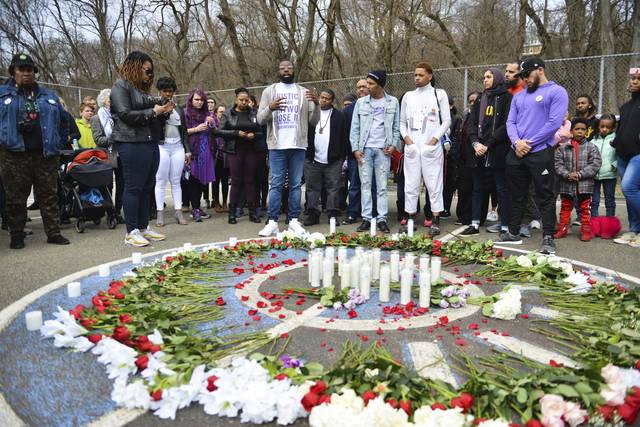
If there is anything we know a year after the death of Antwon Rose II, it is that nothing is black and white.
Even when it seems that everything is black and white.
Rose was black. He was 17. He was a kid running from a cop.
Michael Rosfeld was white. He was a cop. He had a gun.
Those are the facts. They are the steel frame on which everything else hangs, but they aren’t the only facts and they aren’t the only things that matter.
Rose wasn’t just some kid having a run-in with the law. He was a promising writer who took the kind of advanced classes that should have seen him on his way to college and excited about the future. But he had stopped showing up at school.
A June 2018 traffic stop wasn’t just a traffic stop. It wasn’t about speeding or a broken taillight. There had been a shooting. Rose was riding in a car that matched the description. Zaijuan Hester, who pleaded to the drive-by in March, was a passenger, too.
Like with cases nationwide, the situation got out of control. It ended with Rose dead on the ground. Rosfeld was charged but acquitted.
And for almost everyone, it became black and white. On one side, Rose was an unarmed, innocent child, and Rosfeld was overzealous. On the other, Rose was at fault and Rosfeld defending himself and the public.
The problem is that nothing is ever purely black and white, and casting it that way leaves both sides clinging to stories that aren’t entirely accurate. Vilifying either side and glorifying the other does no one any good. It definitely doesn’t help a kid that didn’t get to grow up and a man who has to live with that.
We have to find a way to make police interactions with citizens — particularly people of color and other at-risk communities — safer for all concerned. The solution has to involve both police and the people, and continuing to frame the conversation as heroes and villains gives everyone a reason to think it’s the other side that has to change.
The answer isn’t in shades of gray. It’s in acknowledging a whole spectrum of problems that contribute to the violence that is too commonplace. Poverty, opportunity, employment, crime, addiction, mental health, education. All of those have their own rainbow, too.
It’s too big an issue to reduce to us and them, good and bad, black and white.