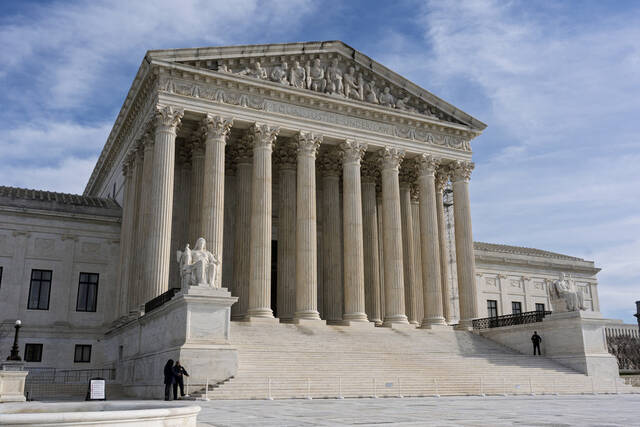
WASHINGTON — The U.S. Supreme Court revived a job-bias lawsuit by a woman who says she suffered so-called reverse discrimination because she’s straight, in a ruling that makes it easier to bring similar cases to trial in parts of the country.
The justices unanimously said a federal appeals court was wrong to require workers in majority groups — including white people, men and heterosexuals — to meet a more difficult test than others that have historically faced discrimination.
The standard for providing job discrimination under federal law “does not vary based on whether or not the plaintiff is a member of a majority group,” Justice Ketanji Brown Jackson wrote for the court.
The ruling comes amid a broad legal and political attack on diversity, equity and inclusion programs. President Donald Trump has made rolling those programs back a top priority in his first months back in the White House. The dispute comes two years after the Supreme Court outlawed consideration of race in university admissions.
In a concurring opinion, Justice Clarence Thomas blasted the use of DEI policies.
“A number of this nation’s largest and most prestigious employers have overtly discriminated against those they deem members of so-called majority groups,” Thomas wrote in an opinion joined by Justice Neil Gorsuch. “American employers have long been obsessed with ‘diversity, equity, and inclusion’ initiatives and affirmative action plans.”
The latest case involved Marlean Ames, who says she was denied a promotion and then demoted from her position at the Ohio Department of Youth Services because she is heterosexual. She says her employer put less qualified gay people in the jobs instead. Ames sued under the main federal job-discrimination law, known as Title VII.
In throwing out her suit, the Cincinnati-based 6th US Circuit Court of Appeals said that Ames needed to show “background circumstances to support the suspicion that the defendant is that unusual employer who discriminates against the majority.” Several other appeals courts had imposed similar requirements before a case could get to a jury.
Ames’ case can now go forward in federal district court in Ohio.
Ames has worked at the department, which oversees juvenile corrections, since 2004. She was promoted to administrator of the department’s Prison Rape Act Elimination Act program in 2014 and applied for a position known as bureau chief in 2019. She not only didn’t get the bureau chief position but was demoted around the same time, with her pay dropping from $47.22 per hour to $28.40.
Ohio officials say that Ames was demoted as part of a broader restructuring and that the new department director found her difficult to work with. Ohio also says Ames hadn’t shown that department officials were even aware of her sexual orientation.
Jackson said the Supreme Court in discrimination cases had long rejected “inflexible” standards like the one at issue adopted by the 6th Circuit. She said the appeals court’s approach would force “majority-group plaintiffs (and only majority-group plaintiffs) to produce certain types of evidence — such as statistical proof or information about the relevant decisionmaker’s protected traits — that would not otherwise be required.”
The case is Ames v. Ohio Department of Youth Services, 23-1039.