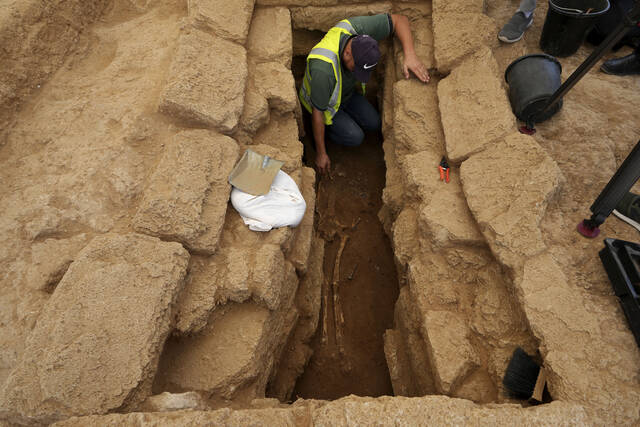
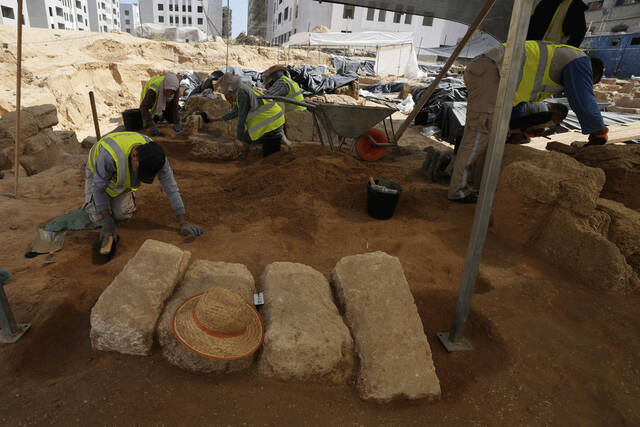

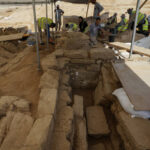
GAZA CITY, Gaza Strip — Palestinian workers in the Gaza Strip have found dozens of ancient graves, including two sarcophagi made of lead, in a Roman-era cemetery — a site dating back some 2,000 years that archaeologists describe as the largest cemetery to be discovered in Gaza.
Workers came upon the site last year during the construction of an Egyptian-funded housing project near Jabaliya, in the northern Gaza Strip. Since then, crews have worked to excavate the 2,700-square-meter (2/3 acre) site with the support of French experts.
Now, what was once an inconspicuous construction lot — surrounded by a grove of nondescript apartment buildings — has become a gold mine for archeologists looking to understand more about the Gaza Strip.
Gaza, a coastal enclave home to some 2.3 million people, has a rich history stemming from its location on ancient trade routes between Egypt and the Levant. But a number of factors — Israeli occupation, Hamas’ 16-year takeover of the territory and rapid urban growth — have conspired to endanger many of the besieged strip’s archaeological treasures.
Against this backdrop, the discovery of 60 graves at the site in January marked a major finding, archaeologists say. That number has swelled to 135.
Rene Elter, a French archaeologist leading the dig, said researchers have studied over 100 of the graves.
“All of these tombs have almost already been excavated and have revealed a huge amount of information about the cultural material and also about the state of health of the population and the pathologies from which this population may have suffered,” said Elter, the head of archaeology for “Intiqal,” a program managed by the French nonprofit Première Urgence Internationale.
Elter pointed to the sarcophagi made of lead — one featuring ornate grape leaves, the other with images of dolphins — as exceptional finds.
“The discovery of lead sarcophagi here is a first for Gaza,” he said.
Given the rarity of the lead tombs, Palestinian archeologists like Fadel Al-Otul suspect that social elites are buried there. Al-Otul said the cemetery probably used to be located in a city — Romans used to place cemeteries near city centers.
Alongside the sarcophagi, Elter’s team is restoring unearthed skeletons and piecing together shards of clay jars.
The skeletons discovered at the site will be sent out of Gaza for additional analysis, according to Al-Otul. The remains are set to return to the Hamas-led Ministry of Antiquities and Tourism.
Elter said the territory needs a dedicated team to oversee archaeological activity in Gaza. “The Gazans deserve to tell their stories,” he said. “Gaza boasts a plethora of potential archaeological sites, but monitoring each one, given the rapid pace of development, is no small feat.”