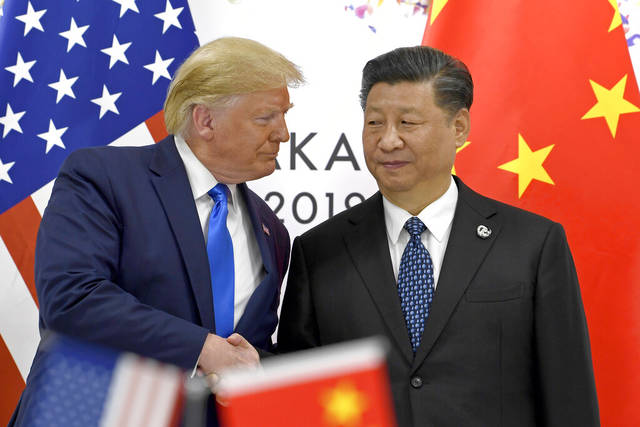
WASHINGTON — The Trump administration is dropping its designation of China as a currency manipulator in advance of the signing Wednesday of a Phase 1 U.S.-China trade agreement.
The preliminary pact that the two sides are set to sign includes a section that’s intended to prevent China from manipulating its currency to gain trade advantages.
The action announced Monday comes five months after the Trump administration had branded China a currency manipulator — the first time that any country had been so named since 1994 during the Clinton administration.
Even while removing China from its currency black list, the Treasury Department does name China as one of 10 countries it says require placement on a watch list that will mean their currency practices will be closely monitored. In addition to China, the countries on that monitoring list are Germany, Ireland, Italy, Japan, South Korea, Malaysia, Singapore, Switzerland and Vietnam.
Treasury Secretary Steven Mnuchin said the administration had dropped China’s designation as a currency manipulator because of commitments in the Phase 1 trade agreement that President Donald Trump is to sign with China on Wednesday at the White House.
“China has made enforceable commitments to refrain from competitive devaluation, while promoting transparency and accountability,” Mnuchin said in a statement accompanying the current report.
The Treasury Department is required to report to Congress twice a year in April and October on whether any countries are manipulating their currencies to gain unfair trade advantages against U.S. businesses and workers.
The new report is technically three months late, apparently because the Trump administration had delayed its release until it had achieved the currency Phase 1 commitments from China.
The initial decision to brand China as a manipulator had come in a surprise announcement in August which reversed a Treasury finding in May that no country was manipulating its currency. The United States had not put any country on the manipulation blacklist since the Clinton administration branded China a manipulator 26 years ago.
The designation is largely symbolic. It requires the United States to enter into negotiations to resolve the currency problem and could ultimately lead to the imposition of economic sanctions such as higher tariffs on Chinese goods, something the Trump administration was already doing in its tit-for-tat trade war with China.