
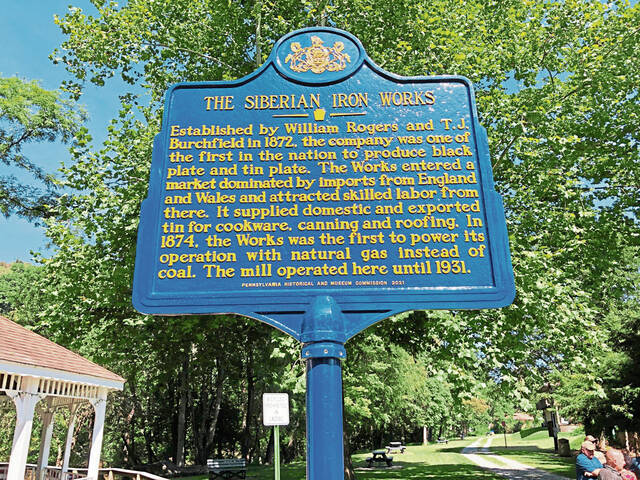


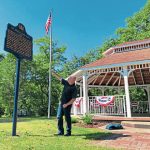
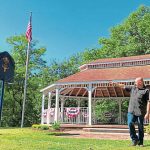
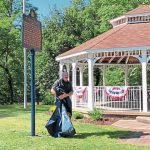
A new state historical marker unveiled Saturday in Leechburg had been turned down the first time borough historian Larry Boehm asked for it.
That was in 2013. He tried again in late 2020 and found out earlier this year that the Pennsylvania Historical & Museum Commission had approved the marker commemorating The Siberian Iron Works.
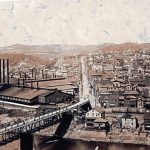
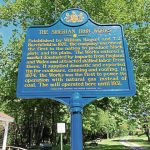
The mill is notable for being one of the first in the United States to use natural gas in steel production. It was one of the earliest foundries in the country for producing black and tin plates on an industrial scale.
Boehm’s submission was a 52-page document.
“It took eight years of fact-finding and data gathering to prove the case this was worth a marker,” Boehm said before he unveiled it in an informal gathering attended by residents and borough officials by the gazebo in Riverfront Park. “I put it together and mailed it at 4 o’clock the day of the deadline. We didn’t expect to get it.”
The historical marker program was started in 1946, and there are more than 2,500 of them across the state chronicling its people, places, events and innovations, said Bill Callahan, the commission’s western region community preservation coordinator.
As Boehm learned, getting a marker is not easy, and there would be thousands more across the state if it were a less selective process.
Of the 14 in Armstrong County, three are in Leechburg, which Boehm thinks is pretty good for a town of Leechburg’s size and population.
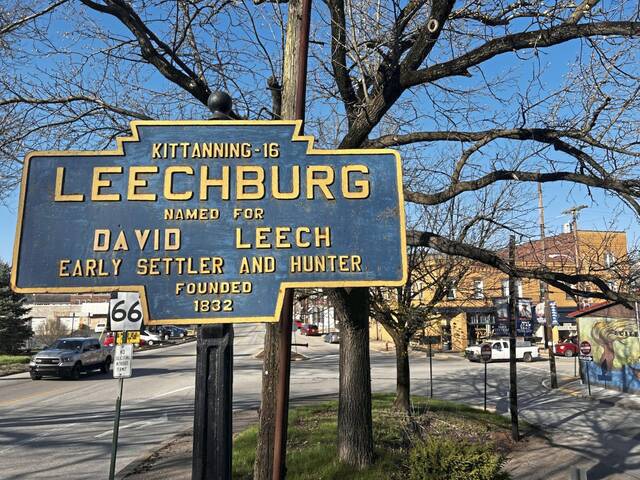
The first in Leechburg, approved in 2017, recognizes the western division of the Pennsylvania Mainline Canal. The other, honoring Leechburg’s namesake David Leech, came in 2019.
“This might be the last one that we do,” said Boehm, president of the Leechburg Area Museum and Historical Society.
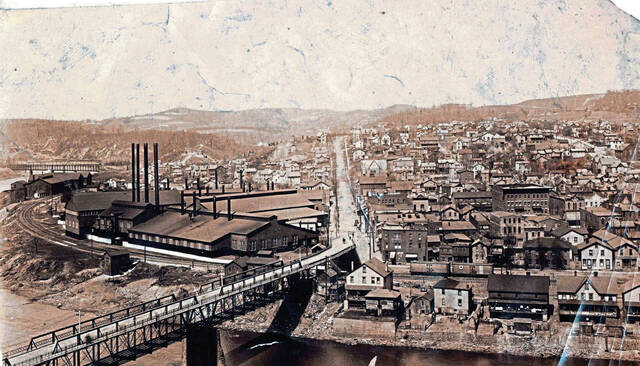
It’s been nearly 90 years since The Siberian Iron Works was torn down. It stood for about 60 years.
Built in 1872 and dismantled in 1932, all that remains of the mill is a small, nondescript wall that was part of its foundation. It’s about 50 feet away from the marker, behind a line of trees and behind Sprankle’s Neighborhood Market.
The mill attracted immigrants from Britain, who added to Leechburg’s population.
Leechburg Mayor Wayne Dobos was among the small crowd who attended the marker’s unveiling. A third generation steelworker, he retired from Allegheny Technologies Inc., previously Allegheny Ludlum, in 2011.
“We’re getting markers put up so other generations will see how important this area really was,” he said. “Now, generations have changed. A lot of the past generations in the steel industry in this area are gone, and people have moved in without ties to the steel industry, so they don’t know anything about it.”
Boehm can talk at length about the company, its history and its significance — a legacy the marker condenses into five sentences.
Callahan said he and the commission hope the sign sparks more discussion.
Boehm said the borough’s three markers help the museum get its history outside, where people can see it, learn it and know it.
“A lot of people think Leechburg is an old canal town,” he said. “A lot of stuff happened here that was pretty significant.”