Western Pennsylvania has a number of ghost towns that thrived during the Industrial Age.
In some cases, not a trace of the towns exist.
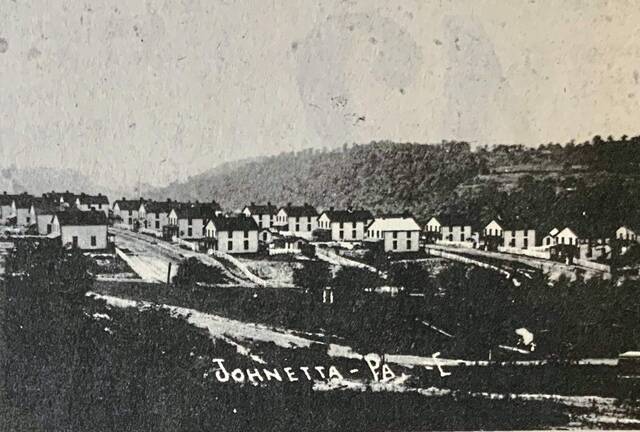
One example in the Alle-Kiski Valley is Johnetta, a town once located along the Allegheny River north of Gilpin Township’s Schenley section.
Johnetta got its start in 1892, when a clay seam about 15 feet thick was discovered after a Kittanning coal seam was mined out.
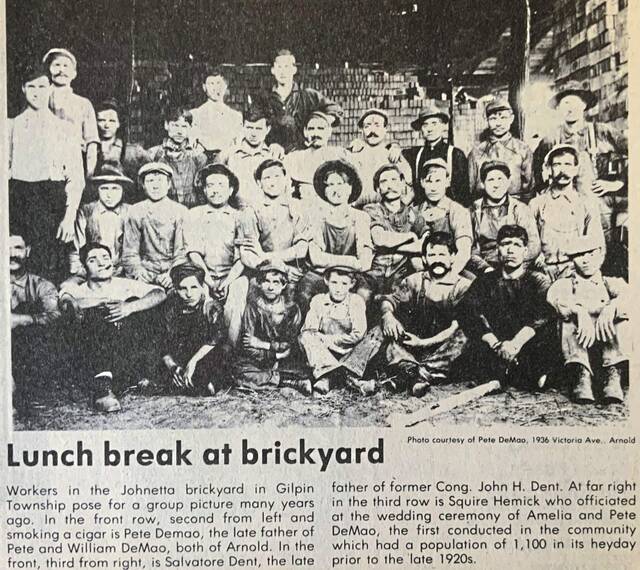
The United States Sewer Pipe Co. was established. Pavers, high-grade bricks and sewer pipes were manufactured by about 500 employees.
The Allegheny Valley Railroad already was laid and the river was handy, so getting the refracted products to market was easy.
Natural gas also was discovered below the clay seam, along with more coal. The town grew quickly.
Johnetta got its name from “John” H. Jones, head of the Pittsburgh-Buffalo Co., and his daughter, “Etta.”
Related
• Remember When: Russellton Medical Group tended to miners' health• Remember When: Polish immigrants built St. Ladislaus Church
• Remember When: Plum native William D. Boyce was founder of Boy Scouts of America
The population rapidly grew to 1,100. Residents enjoyed modern amenities for the time, including municipal sewage and water, along with gas heating. Homeowners were afforded lots large enough for gardening. Fruit and shade trees were planted.
The community consisted of a general store, a schoolhouse, bowling alley, billiards hall, refreshment stand, hotel, post office, the Johnetta Memorial Church, a roller rink that doubled as a town meeting room and, of course, a picturesque view of the Allegheny River.
Times were good in Johnetta.
It was incorporated as a borough in 1902. In 1906, the Johnetta Foundry & Machine Co. was formed. It repaired mining and brickmaking equipment, along with refurbishing railroad cars.
Dr. D.O. Thomas was the town doctor, and Joseph Walbert the postmaster.
But the good times didn’t last.
The collapse of the coal and clay mines closed those facilities. Jones sold the land to Pittsburgh Plate Glass, which set aside 3,600 acres of coal land for a future reserve.
Residents literally packed up and fled the town, often dismantling their homes or moving the residences on wheels. PPG summarily dismantled the remaining homes, the church and the school that taught 98 pupils.
The post office closed in 1929.
Johnetta Borough was dissolved on June 5, 1930, when the municipality’s charter was revoked by Armstrong County Judge Frank J. Graff. It again became part of Gilpin.
Newspapers reported that just six people remained in Johnetta. The Ignatz Paraside family was the last to leave the town.
The road to the former community now is barely passable, and several foundations have been overgrown by foliage.