
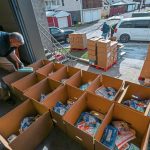
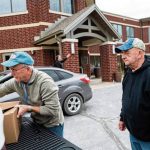


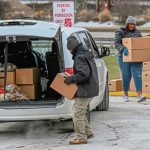
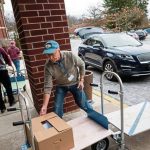
Food banks and pantries across the Pittsburgh area are bracing for an influx of people in need when enhanced covid-era food benefits that have been in place for three years come to an end after this month.
Beginning in March, households getting Supplemental Nutrition Assistance Program benefits — commonly known as SNAP — no longer will receive the second monthly emergency allotment that started in March 2020. They will go back to getting one SNAP payment per month.
“For many of the people we’re serving, they began receiving SNAP benefits as a result of the covid-19 pandemic and economic downturn, and they are very much used to receiving this additional allotment of SNAP benefits,” said Lauren Hill, director of development for the Westmoreland Food Bank. “To have that SNAP benefit amount cut at a time ... when inflation and food costs are still extremely high, it puts people in a very precarious position when it comes to their grocery budget.”
More than 1.9 million people receive SNAP benefits in Pennsylvania, according to the state Department of Human Services. The department says it has distributed more than $4.5 billion in emergency allotments since 2020.
The emergency allotments increased the SNAP benefit to the maximum available amount for a household size or, since early 2021, at least $95.
Colleen Young, director of government affairs for the Greater Pittsburgh Community Food Bank, said they knew the benefit would stop once the public health emergency ended, coming in May, but the timing is “not great.”
“One of the challenges is there’s no phase-out of these benefits. It’s there one month and gone the next. We have not had time to prepare for this,” she said. “Some people are not even aware of it yet. We want people to know that it’s coming. We don’t want anyone to be surprised their benefits are lower than they expected them to be come March.”
Sheila Hughley, who lives in Citizens Plaza Apartments in New Kensington, said she started receiving SNAP benefits when she retired three years ago. For herself and other seniors in her building, the additional payments have helped.
“You have something to make it to the next month,” she said. “It makes a major difference.”
The $1.7 trillion federal Consolidated Appropriations Act of 2023, approved in December, ends states’ authority to issue the emergency allotments after February.
“We know this additional SNAP payment has been a lifeline for people over the past three years and that ongoing economic uncertainty and high food prices are contributing to food insecurity for many Pennsylvanians,” said Val Arkoosh, acting secretary of the Department of Human Services. “There is help available for you and your family through Pennsylvania’s heroic charitable food partners. I urge anyone who can donate food or resources, now is the time to help your local food assistance programs as they prepare to meet this potential additional need.”
Michelle Jackson manages Sally’s Market at the New Kensington Salvation Army. The food pantry is set up like a small grocery store, so people can shop and select the items they want rather than being handed a box. The food comes from donations and grants.
Most of those who come to the market get SNAP benefits, Jackson said.
“We’re going to see a lot more people come in for food,” she said. “When that happens, we will never turn anyone away for food.”
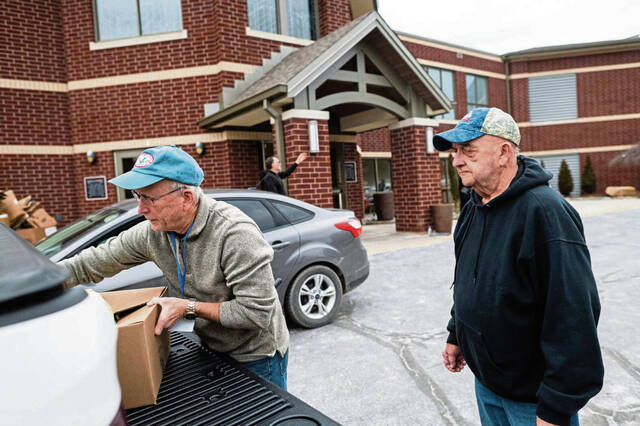
Judy Radcliff manages the Loaves and Fishes food pantry out of Newlonsburg Presbyterian Church in Murrysville. It’s a nonprofit that is not affiliated with any agency, just the community.
She said their numbers had fallen off dramatically during the height of covid.
“It does seem as if covid relief did keep people from attending opportunities to get food — at least that was our experience,” she said. “We are anticipating that to increase as those programs are removed.”
Chelsey Speed is the founder and CEO of The Speed Family Blessing Box & Pantry, a private independent pantry that moved from Verona to Arnold in late 2022.
She is not ready for the extra SNAP benefits to end.
“Everyone’s in an uproar and a panic,” she said. “I’m doing everything I possibly can to get support to brace ourselves for that. It’s going to hit and hit hard.”
John Dick, director of the food pantry at Rosedale United Methodist in Penn Hills, said they saw fewer people coming to their weekly distributions while the extra benefit was available, from an average of 170 down to between 140 and 150.
Its end probably will lead to an increase in need, he said.
“We’ll just provide more food, I guess,” Dick said.
SNAP benefits roll over each month and expire only if a benefit card is not used for nine months. Hill said some recipients have told the Westmoreland food bank that they are trying to make their benefits last longer by stretching out their remaining additional payments into April.
“We are paying the same inflationary rates everyone else is. The cost of doing business at this time is much higher than it previously was,” she said. “To have an increase in demand at this time will be challenging.”
Young said the Greater Pittsburgh food bank is encouraging people to reach out to their county assistance office to ensure their benefit levels are set at the highest possible level.
“There are things they can do to maximize their benefits,” she said. “We want to make sure people are taking advantage of those.”
For those receiving Social Security Income (SSI) and SNAP, there is an additional complication that could see SNAP benefits reduced or eliminated entirely.
Although the 2023 cost-of-living adjustment caused an 8.7% increase in SSI, eligibility thresholds for SNAP did not rise. Because of this, the state Department of Human Services says about 249,000 households will see their base SNAP benefits decrease by an average of $40 per household in March.
The department estimates that between 5,000 and 20,000 households no longer will be eligible to receive SNAP benefits because of the SSI increase.
“They didn’t do us a favor,” Hughley said. “Our government needs to help our senior citizens and quit taking from them.”
But Hughley said she’ll make it. She knows how.
“I may have to eat the same meal for three days. You just have to watch what you eat and how much you use and hope you have enough,” she said. “Thank God for people. People still help people — not our government, but people do. There’s still good people in this world.”