


Raquel Staton said her walks along the trails of Pittsburgh’s Highland Park always included a trip through a historic pedestrian tunnel constructed during park’s early years.
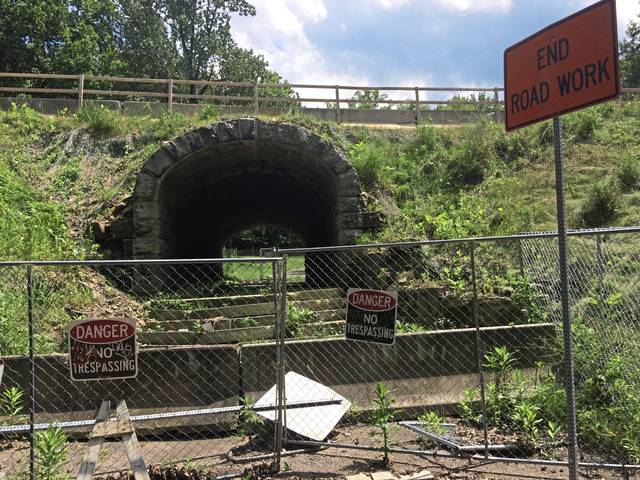
She always found it a little spooky walking through the stone arch tunnel that runs beneath Reservoir Drive.
“I love that tunnel,” said Staton, 36, of the Highland Park neighborhood. “It’s beautiful down there. I definitely think they need to restore it.”
Pittsburgh closed the tunnel two years ago because of safety concerns and is in the process of restoring it with help from the Pittsburgh Parks Conservancy. Erosion, weather and tree roots were pushing out stone blocks and the arched tunnel was in danger of collapse, according to Casimir J. Pellegrini, a city engineer.
“It was a very dangerous situation,” he said. “It was ready to let go.”
The tunnel was built around 1895 from stone quarried at the park as a safe passageway for access to the original Highland Park Zoo and a monument to Alexander Negley, one of Pittsburgh’s earliest settlers, according to Susan M. Rademacher, curator for the Parks Conservancy. Negley and his wife are buried at the site along with about 50 relatives and pioneers.
Pellegrini said the restoration project will cost around $1.7 million and is being delayed until funds are available. The city needs about $1.1 million to finish the job, he said, but that doesn’t include decorative landscaping also in the plans.
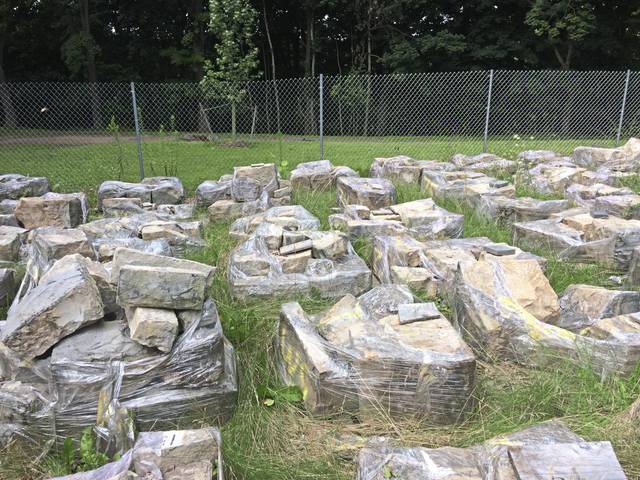
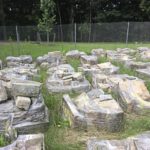
The city hired Graciano Corp. to stabilize the structure. Masons removed rocks and abutments on either side and on top of the tunnel along Reservoir Drive. All have been numbered and catalogued so they can be replaced in their exact original positions, Pellegrini said. The stone is being stored on site and secured with fencing.
An engineering firm determined the tunnel arch is secure and hasn’t moved since it was built, Pellegrini said.
It is one of three stone arch pedestrian tunnels in city parks, according to Rademacher. The others are in Schenley Park and Point State Park. The idea of park pedestrian tunnels known as the “separation of ways” was invented by famous landscape architect Frederick Law Olmsted.
“It was a very important part of the circulation system, the path system in Highland Park,” Rademacher said, adding that the tunnel is part of the Ginkgo Trail. “It’s very important that we preserve these forward looking modes of moving people through a park with great ease and comfort and safety. That is why there is an impetus to repair and restore this underpass.”
Ginkgo Trail starts at the park’s main entrance and well-known flower gardens and runs through the tunnel to the Negley monument. The city has blocked the entrances off with fencing until restoration is complete.
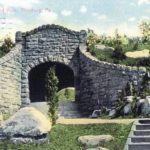
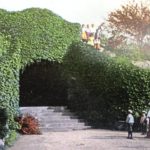
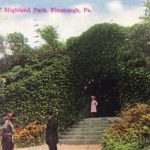
The tunnel was a very popular scenic attraction during the Victorian Era. Slopes on either side were landscaped with boulders and greenery. Postcards from the era feature women with parasols and children posing beside the tunnel and on its slopes.
“It really is one of the unique, original features in the park,” said Monica Watt, a Highland Park resident and former president of the Highland Park Community Council. “It was just a wonderful area where families used to be able to stroll on a nice day.”