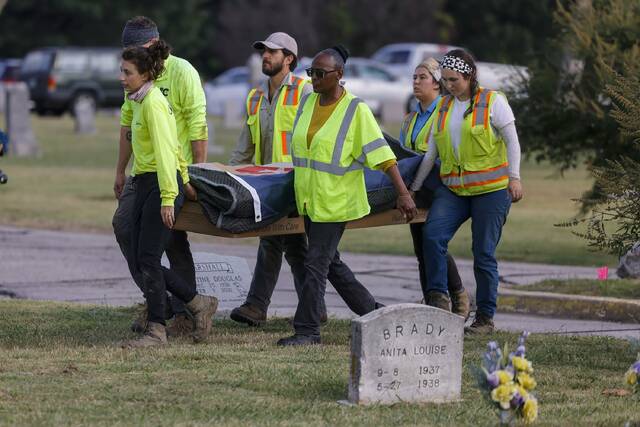
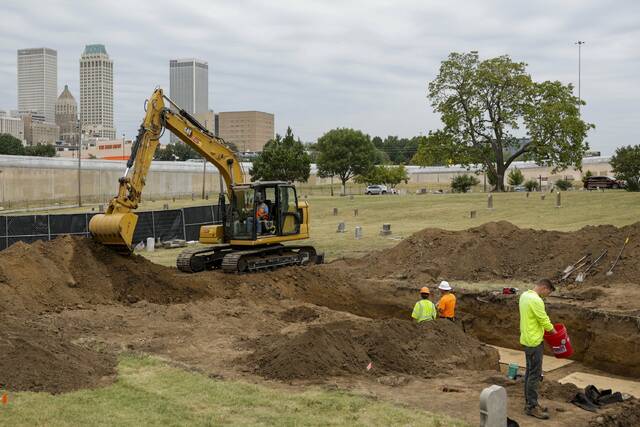
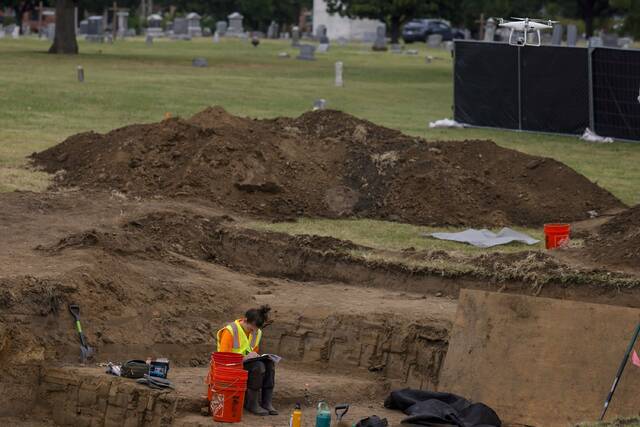

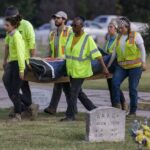
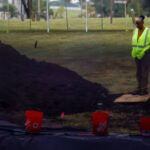
OKLAHOMA CITY — Archaeologists have exhumed the remains of one person and plan to exhume a second set as the search for victims of the 1921 Tulsa Race Massacre resumes in a Tulsa cemetery.
The remains are among 22 sets found during the current search in Oaklawn Cemetery, but are the only ones found in simple, wooden caskets as described by newspaper articles, death certificates and funeral home records, Oklahoma state archaeologist Kary Stackelbeck said Thursday.
“That basically suggests that we had a number of adult male individuals that were supposed to be buried in simple, wood coffins,” Stackelbeck said.
One set was taken to an onsite forensics laboratory Thursday and the second is to be excavated on Friday, Stackelbeck said. Both are of adults although the gender was not immediately known.
The latest search began Sept. 5 and is the third such excavation in the search for remains of the estimated 75 to 300 Black people killed during the 1921 massacre at the hands of a white mob that descended on the Black section of Tulsa — Greenwood.
More than 1,000 homes were burned, hundreds more were looted and destroyed and a thriving business district known as Black Wall Street was destroyed.
None of the remains have been confirmed as victims of the violence.
Previous searches have resulted in 66 sets of remains located and 22 sent to Intermountain Forensic in Salt Lake City in an effort to identify them.
Of those 22, six sets of remains have produced genetic genealogy profiles that have been connected to potential surnames and locations of interest, according to Tulsa Mayor G.T. Bynum. Investigators have tracked the surnames associated with the bodies to at least seven states: North Carolina, Georgia, Texas, Mississippi, Louisiana, Oklahoma and Alabama.
The search area was chosen after ground penetrating radar found what appeared to be “makeshift” grave markers such as upright bricks and flower pots in rows, Stackelbeck said.
The search is believed to be in or near the area where a man named Clyde Eddy said in the 1990s that, as a 10-year-old boy, he saw Black bodies being prepared for burial shortly after the massacre, but was told to leave the area, according to Stackelbeck.
Bynum, who first proposed looking for the victims in 2018, and later budgeted $100,000 to fund it after previous searches failed to find victims, said at the beginning of the current excavation that trying to find people who were killed and buried more than 100 years ago is a challenge.
“It’s not that we’re trying to find a needle in a haystack, it’s that we’re trying to find a needle in a pile of needles,” Bynum said. “We’re trying to find people who were murdered and buried in a cemetery … without the intent of being found.”
The three known living survivors of the massacre are appealing a ruling that dismissed their lawsuit seeking reparations from the city and other defendants for the destruction of the once-thriving Black district.