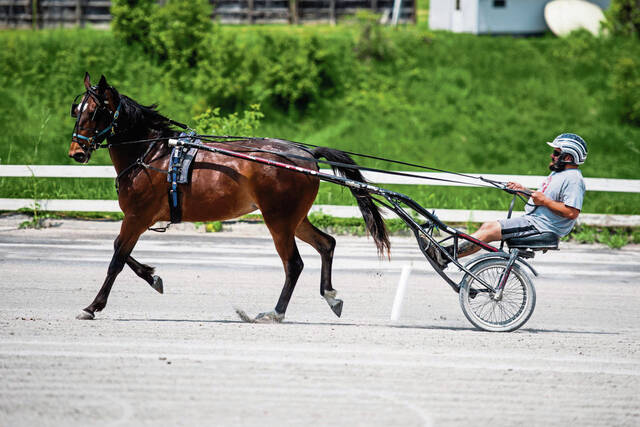


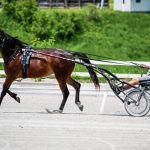
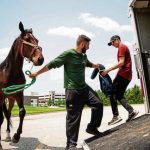

Veteran sport horse trainer and harness race driver Mike Wilder respects the art of balance.
After 38 years as a driver and more than 8,800 wins in his career, he scrutinizes many factors when it comes to taking care of his athletes — the horses expected to run at least 30 mph while pulling a 39-pound cart and a driver for a mile around a track.
“Everything is important,” said Wilder, who runs Altmeyer Wilder Racing with his family. “We prepare these athletes for competition. We see how good they look, the care they get, and what it takes to get there.”
While Wilder’s home track for harness racing is nearby — Hollywood Casino at the Meadows in Washington County — the focus of the horse racing community this year has been on horses’ health after the shocking deaths of thoroughbreds at Triple Crown events.
The Belmont Stakes, the third leg of the famed Triple Crown set for today in New York, is the latest race in a season marred by the deaths of 12 thoroughbreds at the first two events — the Kentucky Derby and Preakness Stakes.
Five horses were euthanized after training and racing incidents at Churchill Downs in Louisville, Ky., in the days leading up to the derby. Four horses died in the beginning of the week, and two others died when they collapsed after racing.
Two weeks later, a horse was euthanized after getting injured during an undercard race at the Preakness track in Pimlico, Md.
All racing operations are halted at Churchill Downs while the Kentucky Horse Racing Commission and the Horseracing Integrity and Safety Authority, a private self-regulatory organization, investigate.
In Pennsylvania, the state Horse Racing Commission adopted a 10-step equine safety and welfare outline and integrity hotline in January 2022 to comply with the federal standards for horse safety.
There were 102 horse deaths at tracks statewide from all of 2022 to April 2023.
Staying healthy
While the national race horse deaths are in the spotlight, local training and rehab facilities — and the veterinarians who serve them — keep a watchful eye on the athletes prone to injuries that many times necessitate euthanasia.
“There is a ton of advanced medicine out there. But at the end of the day, you’re still dealing with a 1,200-pound animal that is standing on toothpicks,” said Andrew Stas, veterinarian and owner at Lakeview Animal Clinic in Latrobe.
“It’s been a bad year for horses, and people have seen some of the actions that owners and trainers have to take,” Stas said. “Making those decisions has nothing to do with money. It’s not that they don’t want to pay for the treatment or don’t want to bother with it — there’s so much that goes into those decisions. When those happen, it is an absolutely humane decision.”
Treatment can become complicated when there are fractures, tears or breakdowns of a horse’s lower limbs, which can cause a domino effect for injuries to other ligaments in the animal’s body, Stas said. It’s difficult for the uninjured legs to support the rest of the horse’s bodyweight because of its heavy torso compared to the fine leg bones.
Samantha Farabee, associate veterinarian at Performance Equine in Washington County, said while most leg fractures and breaks can be healed with today’s technology and medicine, factors such as weather, the horse’s footing, the jockey’s position, and location of other horses on the track can affect the severity of an injury.
She said professionals often have to examine the damage not only to the bone but also the soft tissue, tendons and ligaments.
“Just because a horse breaks its leg does not automatically mean that the horse has to be put down,” Farabee said. “With a certain type of fracture, when the bone breaks right in half or when the bone splinters throughout the leg, there is no structural foundation to fix it.”
Stas compared a horse breaking its leg to bumping into a house of cards. Farabee compared the injury to removing a piece from a Jenga game and watching the tower fall.
“Everything is so precise and formed so perfectly that one thing goes out and the rest kind of follows with it,” Stas said.
Putting a horse down at the track is necessary after a severe injury because it’s difficult to move the animal without aggravating the injury or causing more injuries down the road.
“They know that the horse likely won’t survive the injury and don’t want to put it through that level of suffering for a small percentage chance of survival,” Stas said.
Farabee pointed out that smaller animals have their weight more evenly distributed and are able to remain stable on three legs without damaging the rest of their body.
Horses do not. Horses also do not have the option of getting plates or joint replacements.
“Horses carry about 60% of their weight in their front legs,” Farabee said. “Usually, a front leg injury is more devastating than a hind leg injury, just based on their body anatomy.
“It would be like if we put all of our weight on our middle finger. They’re putting all of their weight — about 1,000 pounds — on what would be our fingernails.”
Wilder and his team keep equine veterinarians on call in case one of the horses is injured. Mobile vet kits are used to help the animals after training or races at The Meadows track, where the average mile time for a harness race is between 1 minute, 50 seconds and a little more than 2 minutes.
According to the state racing commission, The Meadows reported four horse deaths in all of 2022 to April 2023. Three of those deaths occurred when a horse was in the track facility but not training or racing.
Kim Hankins, executive director of the Meadows Standardbred Owners Association, said vets are on the grounds at all times and that the state sends a vet to the site each race day. Each competing horse on race day is required to complete a health exam.
“Horses are very, very good at getting themselves hurt,” Stas said. “They’re naturally very curious animals and very easily spooked.”